ABSTRACT:
OFDM otherwise called orthogonal frequency division
multiplexing is a modulation and a multiple access technique that can be
applied to mobile communications. OFDM or Multitone modulation as it is
sometimes called is the basis for several commercial wireless applications. In
OFDM the segments are according to frequency there by dividing the spectrum
into a number of equally spaced tones, which are orthogonal with each other and
carries a portion of user information on each tone. As the mobile cellular
wireless system operates under harsh and challenging channel conditions, the wireless
channel is distinct and much more unpredictable than the wired because of the
factors such as multipath fading, shadow fading, Doppler spread and time
dispersion or delay spread. OFDM over comes the ISI (intersymbol interference)
in a multipath environment.
In order to combat these effects the modern wireless
systems employ a variety of signal processing techniques, which include the
factors such as equalization, error correction coding, spread spectrum,
interleaving and diversity. The sinusoidal waveforms making up the OFDM tones
have the very special property of being the only eigen functions of a linear
channel. With this property and the incorporation of small amount of guard
time, called the cyclic prefix to each symbol enables the orthogonality between
tones to be preserved in the presence of multipath. The cyclic prefix allows
the tones to be realigned at the receiver thus regaining orthogonality and is
used to absorb transients
from previous bursts caused by multipath. Thus OFDM
eliminates the effect of multipath, ISI (intersymbol interference), ICI
(intercarrier interference) in Mobile channels.
INTRODUCTION:
OFDM represents a different system-design approach.
It can be thought of as a combination of modulation and multiple-access schemes
that segments a communications channel in such a way that many users can share
it. Whereas TDMA segments are according to time and CDMA segments are according
to spreading codes, OFDM segments are according to frequency. It is a technique
that divides the spectrum into a number of equally spaced tones and carries a
portion of a user's information on each tone. A tone can be thought of as a
frequency, much in the same way that each key on a piano represents a unique
frequency. OFDM can be viewed as a form of frequency division multiplexing
(FDM), however, OFDM has an important special property that each tone is
orthogonal with every other tone. FDM typically requires there to be frequency
guard bands between the frequencies so that they do not interfere with each
other. OFDM allows the spectrum of each tone to overlap, and because they are
orthogonal, they do not interfere with each other.
DEFINITION:
Orthogonal frequency division multiplexing (OFDM) is
a communications technique that divides a communications channel into a number
of equally spaced frequency bands. A subcarrier carrying a portion of the user
information is transmitted in
each
band. Each subcarrier is orthogonal (independent of each other) with every
other subcarrier, differentiating OFDM from the commonly used frequency
division multiplexing (FDM).
OVERVIEW OF
OFDM:
This paper describes OFDM and its application to
mobile communications. OFDM is a modulation and multiple-access technique that
has been explored for more than 20 years. Only recently has it been finding its
way into commercial communications systems, as Moore's Law has driven down the
cost of the signal processing that is needed to implement OFDM–based systems.
OFDM, or multitone modulation as it is sometimes
called, is presently used in a number of commercial wired and wireless
applications. On the wired side, it is used for a variant of digital subscriber
line (DSL). For wireless, OFDM is the basis for several television and radio
broadcast applications, including the European digital broadcast television
standard, as well as digital radio in North America. OFDM is also used in
several fixed wireless systems and wireless local-area network (LAN) products.
A system based on OFDM has been developed to deliver mobile broadband data
service at data rates comparable to those of wired services, such as DSL and cable
modems.
OFDM enables the creation of a very flexible system
architecture that can be used efficiently for a wide range of services,
including voice and data. For any mobile system to create a rich user
experience, it must provide ubiquitous, fast, and user-friendly connectivity.
OFDM has several unique properties that make it especially well suited to
handle the challenging environmental conditions experienced by mobile wireless
data applications.
OFDM
FOR MOBILE COMMUNICATIONS:
OFDM represents a different system-design approach.
It can be thought of as a combination of modulation and multiple-access schemes
that segments a communications channel in such a way that many users can share
it. Whereas TDMA segments are according to time and CDMA segments are according
to spreading codes, OFDM segments are according to frequency. It is a technique
that divides the spectrum into a number of equally spaced tones and carries a
portion of a user's information on each tone. A tone can be thought of as a
frequency, much in the same way that each key on a piano represents a unique
frequency. OFDM can be viewed as a form of frequency division multiplexing
(FDM), however, OFDM has an important special property that each tone is
orthogonal with every other tone. FDM typically requires there to be frequency
guard bands between the frequencies so that they do not interfere with each
other. OFDM allows the spectrum of each tone to overlap as shown in the fig1,
and because they are orthogonal, they do not interfere with each other. By
allowing the tones to overlap, the overall amount of spectrum required is
reduced.

OVERVIEW
OF THE WIRELESS ENVIRONMENT:
Mobile cellular wireless systems operate under harsh
and challenging channel conditions. The wireless channel is distinct and much
more unpredictable than the wireline channel because of factors such as
multipath and shadow fading, Doppler spread, and time dispersion or delay
spread.
Multipath is a phenomenon that occurs as a
transmitted signal is reflected by objects in the environment between the base
station and a user. These objects can be buildings, trees, hills, or even
trucks and cars. The reflected signals arrive at the receiver with random phase
offsets, because each reflection generally follows a different path to reach
the user's receiver. The degree of cancellation, or fading, will depend on the
delay spread of the reflected signals, as embodied by their relative phases, and
their relative power.


Fig 1. Time Delayed multipath
signals
Courtesy: Internet
Time dispersion represents distortion to the signal
and is manifested by the spreading in time of the modulation symbols. This
occurs when the channel is band-limited, or, in other words, when the coherence
bandwidth of the channel is smaller than the modulation bandwidth. Time
dispersion leads to intersymbolinterference, or ISI, where the energy from one
symbol spills over into another symbol, and, as a result, the BER is increased.
It also leads to fading.

Fig2. Demonstration of multipath
reflections
Courtesy: Internet
In many instances, the fading due to multipath will
be frequency selective, randomly affecting only a portion of the overall
channel bandwidth at any given time. Frequency selective fading occurs when the
channel introduces time dispersion and when the delay spread exceeds the symbol
period. When there is no dispersion and the delay spread is less than the
symbol period, the fading will be flat, thereby affecting all frequencies in
the signal equally. Flat fading can lead to deep fades of more than 30 decibels
(dB).


Fig3. Demonstration of time
varying fading
Courtesy: Internet
Doppler spread
describes the random changes in the channel introduced as a result of a user's
mobility and the relative motion of objects in the channel. Doppler has the
effect of shifting, or spreading, the frequency components of a signal. The
coherence time of the channel is the inverse of the Doppler spread and is a
measure of the speed at which the channel characteristics change. This in
effect determines the rate at which fading occurs. When the rate of change of
the channel is higher than the modulated symbol rate, fast fading occurs. Slow
fading, on the other hand, occurs when the channel changes are slower than the
symbol rate.
The statistics
describing the fading signal amplitude are frequently characterized as either
Rayleigh or Ricean. Rayleigh fading occurs when there is no line of sight (LOS)
component present in the received signal. If there is a LOS component present,
the fading follows a Ricean distribution. There is frequently no direct LOS
path to a mobile, because the very nature of mobile communications means that
mobiles can be in a building or behind one or other obstructions. This leads to
Rayleigh fading but also results in a shadow loss. These conditions, along with
the inherent variation in signal strength caused by changes in the distance
between a mobile and cell site, result in a large dynamic range of signals,
which can easily be as much as 70 dB.
OVERVIEW OF TRADITIONAL MOBILE WIRELESS
SYSTEMS:
All modern mobile
wireless systems employ a variety of techniques to combat the aforementioned
effects. Some techniques are more effective than others, with the effectiveness
depending on the air-interface and the system-architecture approach taken to satisfy
the requirements of the services being offered. As mobile systems evolved from
analog to digital, more sophisticated signal-processing techniques have been
employed to overcome the wireless environment. These techniques include
equalization, channel or error-correction coding, spread spectrum,
interleaving, and diversity.
Diversity has long been
used to help mitigate the multipath-induced fading that results from users'
mobility. The simplest diversity technique, spatial diversity, involves the use
of two or more receive antennae at a base station that are separated by some
distance, say on the order of five to 10 wavelengths. The signal from the
mobile will
generally
follow separate paths to each antenna. This relatively low-cost approach yields
significant performance improvement by taking advantage of the statistical
likelihood that the paths are not highly correlated with each other. When one
antenna is in a fade, the other one will generally not be.
Spread spectrum systems employ a form of diversity
called frequency diversity. Here the signal is spread over a much larger
bandwidth than is needed for transmission and is typically greater than the
coherence bandwidth of the channel. A wideband signal is more resistant to the
effect of frequency selective fading than is a narrowband signal, because only
a relatively small portion of the overall bandwidth use is likely to experience
a fade at any given time. There are two forms of spread spectrum, code division
multiple access (CDMA) and frequency hopping (FH).
OPERATION OF
OFDM:
The sinusoidal waveforms making up the tones in OFDM
have the very special property of being the only Eigen-functions of a linear
channel. This special property prevents adjacent tones in OFDM systems from
interfering with one another, in much the same manner that the human ear can
clearly distinguish between each of the tones created by the adjacent keys of a
piano. This property, and the incorporation of a small amount of guard time to
each symbol, enables the orthogonality between tones to be preserved in the
presence of multipath. This is what enables OFDM to avoid the multiple-access
interference that is present in CDMA systems.
The frequency domain representation of a number of
tones, shown in Figure 1 highlights the orthogonal nature of the tones used in
the OFDM system. Notice that the peak of each tone corresponds to a zero level,
or null, of every other tone. The result of this is that there is no
interference between tones. When the receiver samples at the center frequency
of each tone, the only energy present is that of the desired signal, plus
whatever other noise happens to be in the channel.


Fig4. Two-dimensional
illustration of ofdm channel resource
Courtesy: Internet
To maintain orthogonality between tones, it is
necessary to ensure that the symbol time contains one or multiple cycles of
each sinusoidal tone waveform. This is normally the case, because the system
numerology is constructed such that tone frequencies are integer multiples of
the symbol period, as is subsequently highlighted, where the tone spacing is
1/T. Viewed as sinusoids. The below figure shows three tones over a single
symbol period, where each tone has an integer number of cycles during the
symbol.

.

Fig5. Time- and frequency-domain
representation
Courtesy: Internet

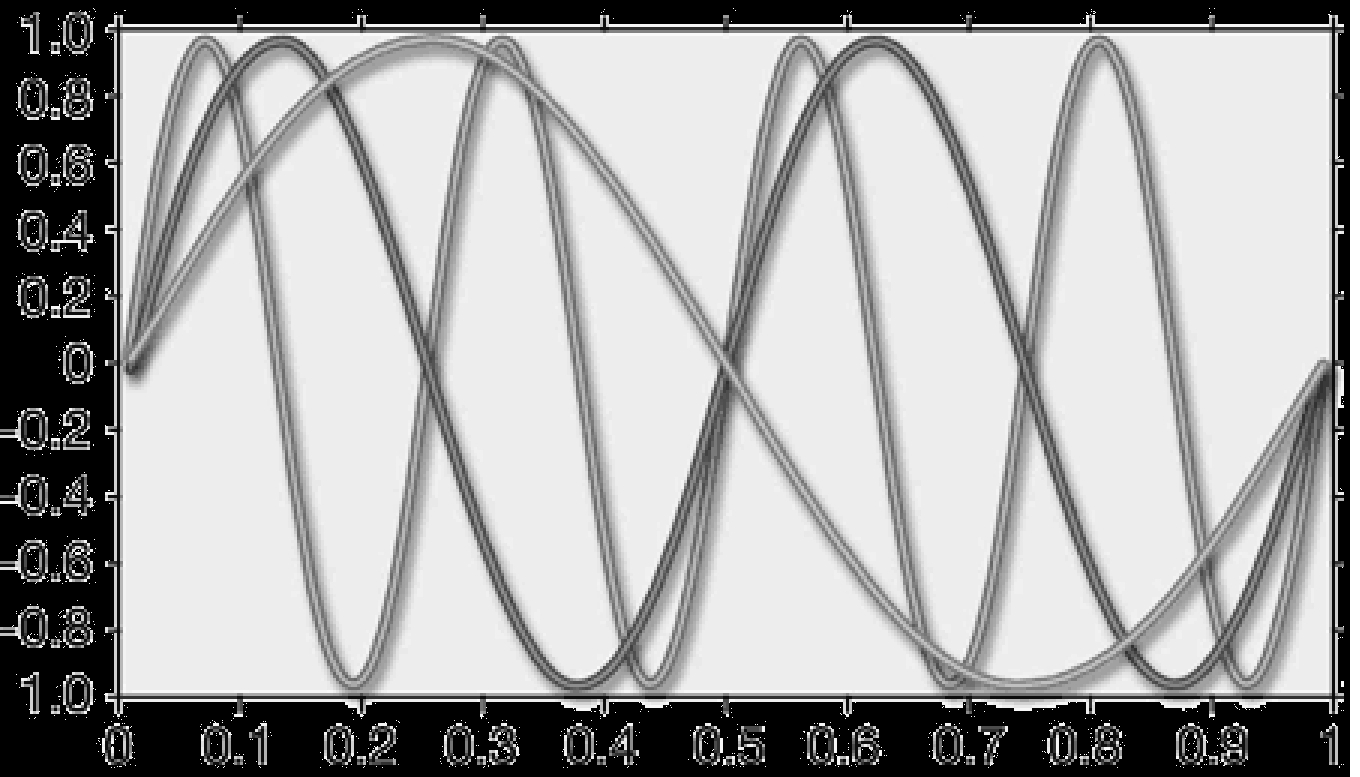
Fig6. Integer number of sinusoid
periods
Courtesy: Internet
In absolute terms, to generate a pure sinusoidal
tone requires the signal start at time minus infinity. This is important,
because tones are the only waveform than can ensure orthogonality. Fortunately,
the channel response can be treated as finite, because multipath components
decay over time and the channel is effectively band-limited. By adding a guard
time, called a cyclic prefix, the channel can be made to behave as if the
transmitted waveforms were from time minus infinite, and thus ensure orthogonality,
which essentially prevents one subcarrier from interfering with another (called
intercarrier interference, or ICI).
Multipath causes tones and delayed replicas of tones
to arrive at the receiver with some delay spread. This leads to misalignment
between sinusoids, which need to be aligned as in fig shown below to be
orthogonal. The cyclic prefix allows the tones to be realigned at the receiver,
thus regaining orthogonality.


Fig7. Cyclic extension of
sinusoid
Courtesy: Internet
The cyclic prefix is sized appropriately to serve as
a guard time to eliminate ISI. This is accomplished because the amount of time
dispersion from the channel is smaller than the duration of the cyclic prefix.
A fundamental trade-off is that the cyclic prefix must be long enough to
account for the anticipated multipath delay spread experienced by the system.
The amount of overhead increases, as the cyclic prefix gets longer. The sizing
of the cyclic prefix forces a tradeoff between the amount of delay spread that
is acceptable and the amount of Doppler shift that is acceptable.
CONCLUSION:
This tutorial highlights the unique design
challenges faced by mobile data systems that result from the vagaries of the
harsh wireless channel, the wide and varied service profiles that are enabled
by data communications, and the performance of wireline-based protocols, such
as TCP/IP, with the realities of wireless links. OFDM has been shown to address
these challenges and to be a key enabler of a system design that can provide
high-performance mobile data communications.
